
Stuck on Solutions
when we're not stuck on problems

Stuck On Solutions
I gave a short presentation the other day in Thurles on climate change.
.
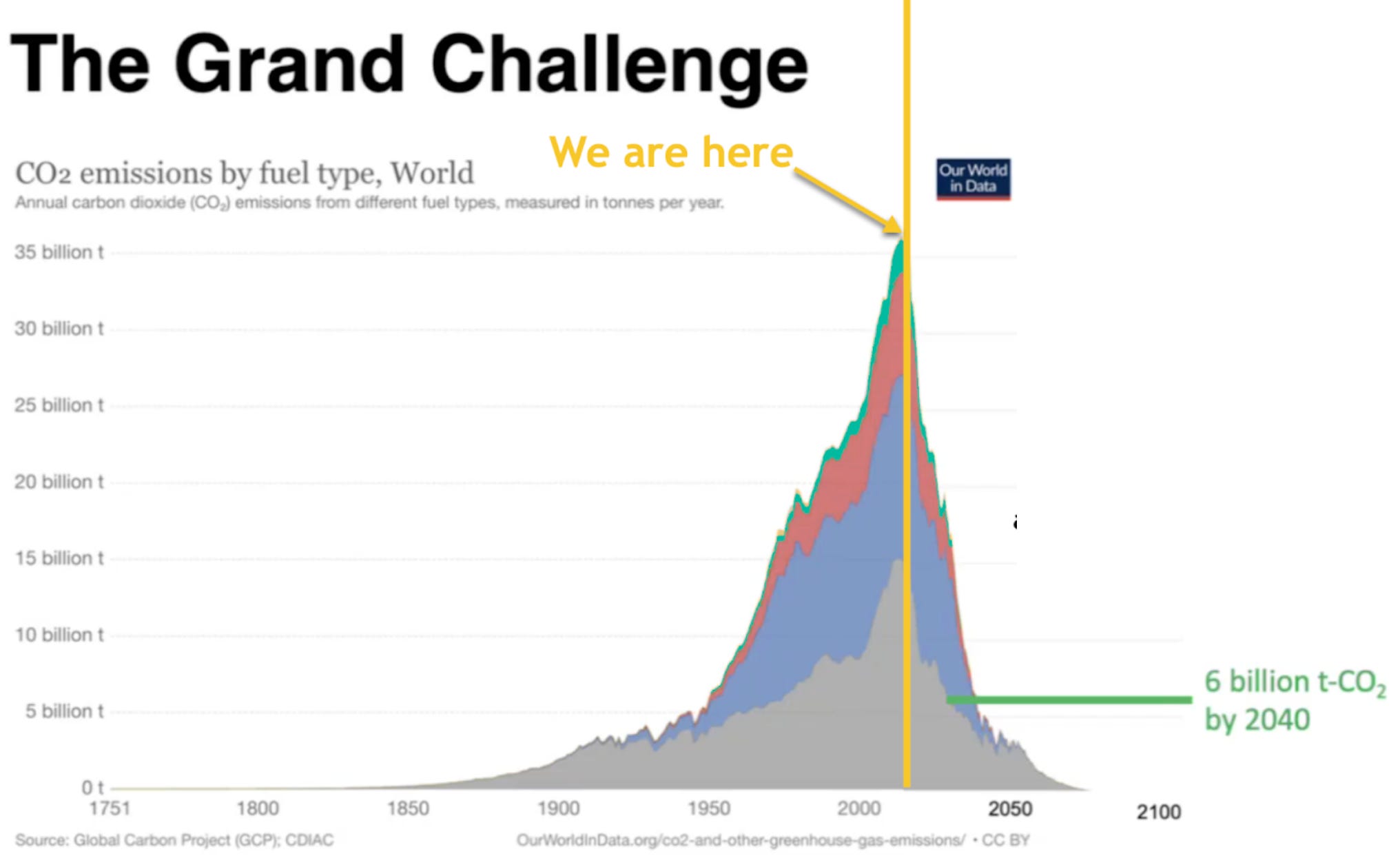
The orange line being where we are now and the dive down to the right being what 200+ countries committed to in 2015 under the Paris Agreement.
Later I showed this image:
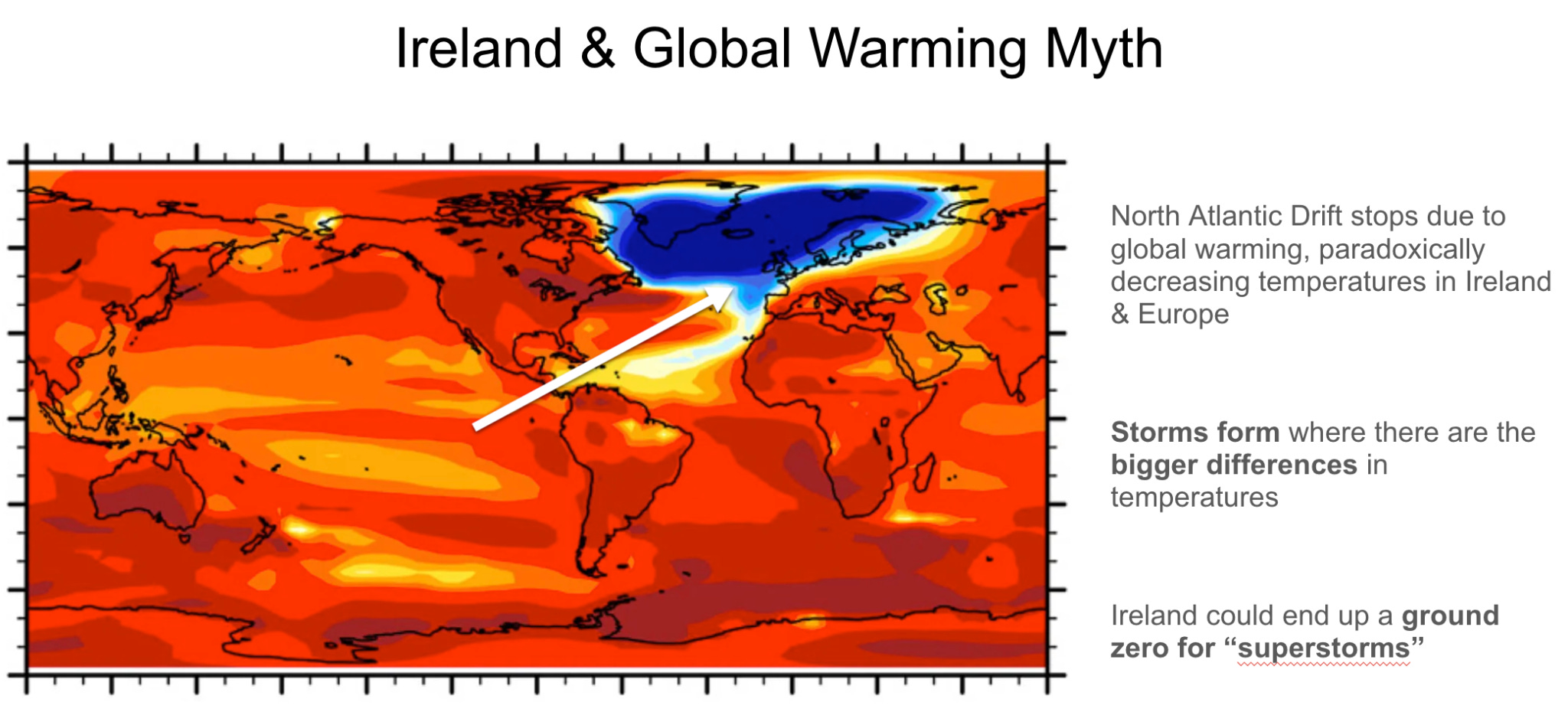
I spoke of the myth that Ireland will be largely unaffected by global warming, showing the image above from the IPCC report forecasting average temperatures globally after the AMOC current has shut down, which it is on its way to doing. Since the greater the difference in temperatures in adjacent areas, the more violent the storms, Ireland would find itself at ground zero for superstorms.
At this point, I’m sure some in the audience were saying “renewables!”, which is when I disappointed them with this:
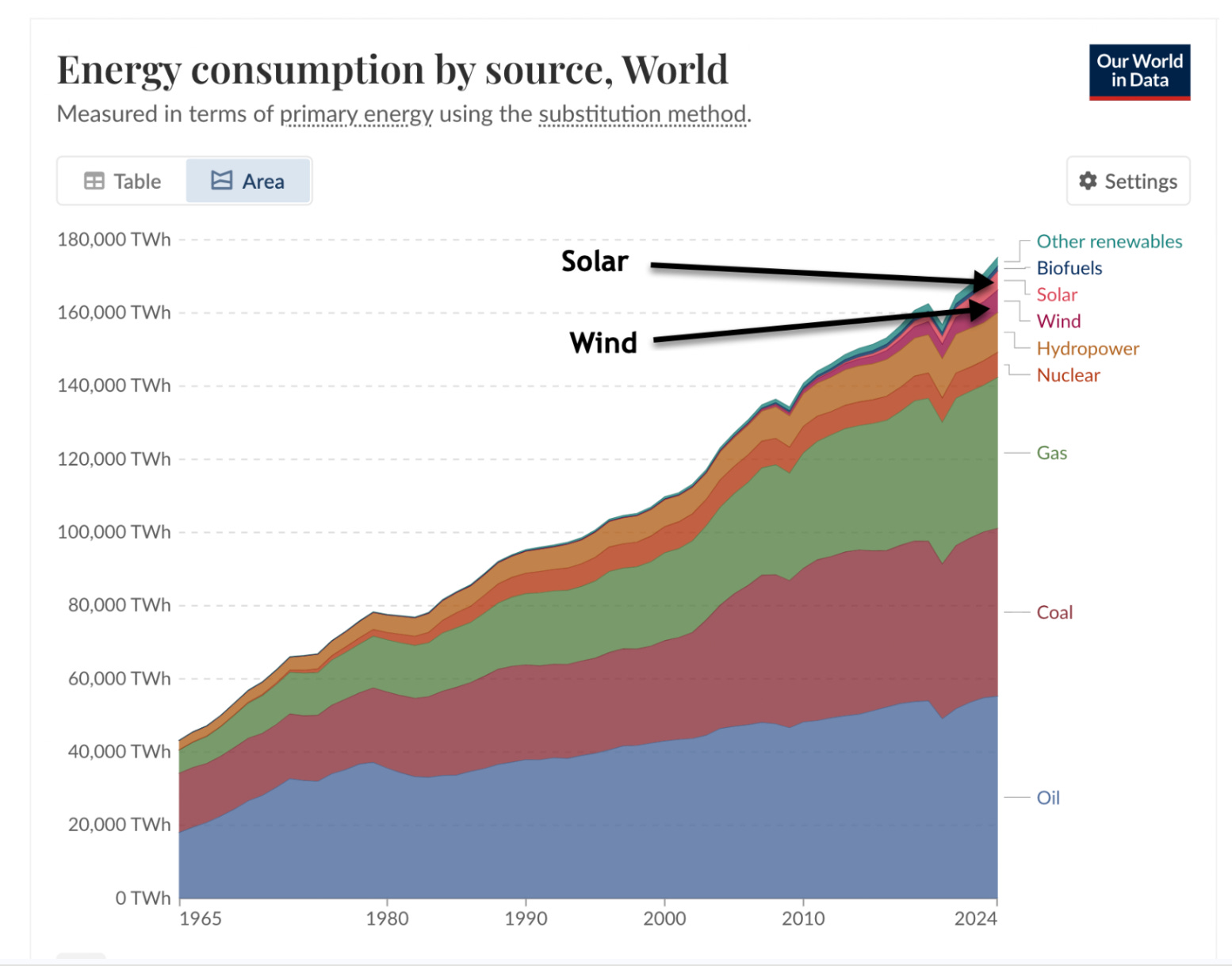
And this:
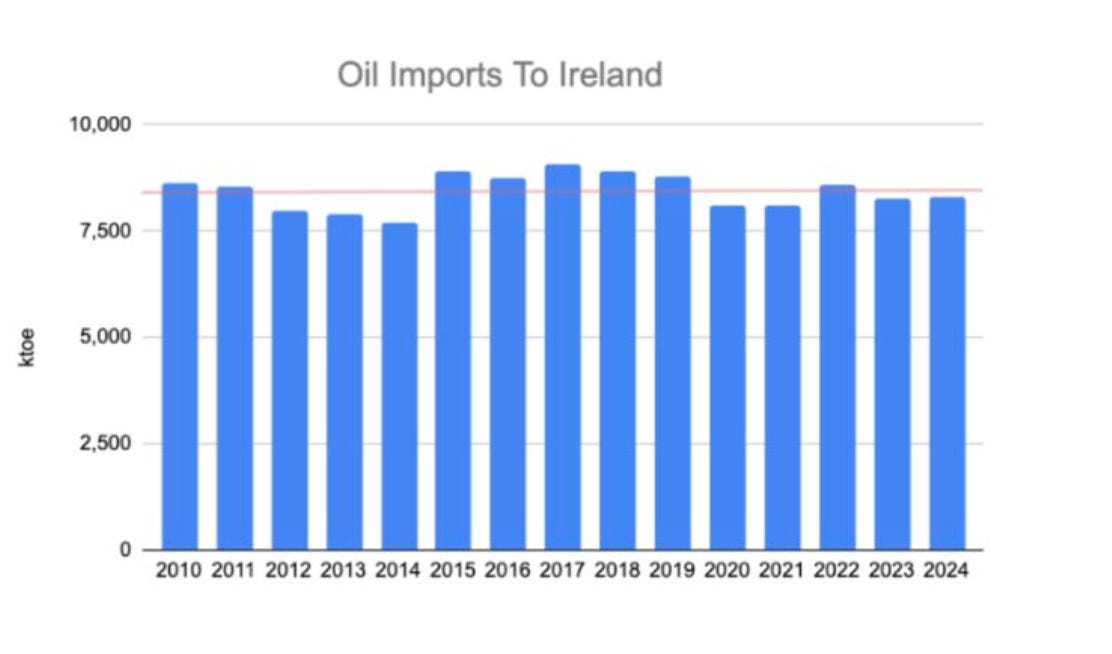
Oil imports aren’t budging despite 25 years of energy transition in Ireland. To be sure, the population has risen since 2010 so there has been some decrease in oil per capita, but a baseline of oil use seems to be persisting no matter how many wind turbines we throw at it.
The recent argument over nuclear energy v renewables is moot since clean electricity is not reducing our dependence on oil. We could have thousands of offshore wind turbines or 7 SMRs and the line above wouldn’t change. This is mostly because Irelands physical economy is entirely dependent on diesel truck. Every product gets moved around the country and delivered to its destination using diesel trucks. We’re alone in Europe for having no way of moving stuff with clean electricity having built none of the electric rail the Europeans built decades ago.
In my experience there are 2 groups vocal about climate change and the energy crisis. Those who think nothing can be done as it’s too late. And those that put forward one neat solution wrapped in a ribbon - “offshore wind!”, “just cut emissions!”, “electric trucks!“, “nuclear!”, “drill baby drill!”
That first group is stuck on problems, and that second group is stuck on solutions.
Later, I presented the audience with a thought experiment: “Imagine if you found 2 empty islands, and you decided to build a society powered by fossil fuels on the first island, and a society powered by wind and solar on the other island….The islands would look completely different!”
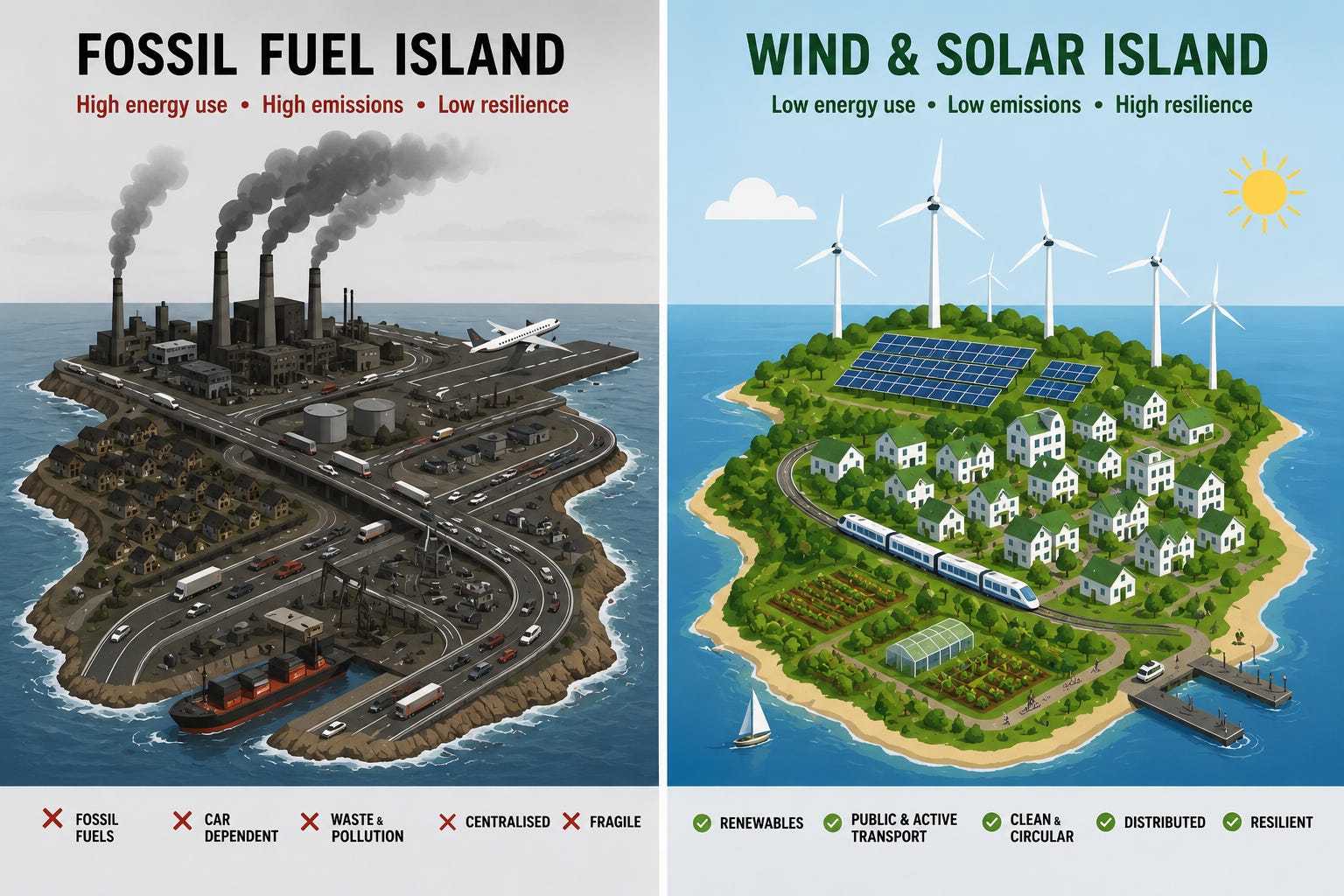
Just adding wind turbines to the first island won’t make it look like the second island.
At this point I got on to the meat of my talk - something called Transition Engineering - a way to tackle really hard problems and move past getting stuck on problems or solutions.
There’s a series of steps to Transition Engineering, with one of the steps being to imagine an ideal future 100 years from now where the problem we’re looking at has been solved. In that future, the climate is stable and people are having their needs met without fossil fuels. Or with very little: oil is thousands of dollars a barrel and only used for essentials like healthcare. Coal is exclusively used to produce wind turbines and solar panels. The primary mode of transport is electric rail. Cities are car-free and bustling with street markets and craftmanship. Primary energy available to society has dropped by 80%. Resources are constrained. People are happy.
Here’s a real life example:
An oil company came to the Transition Engineering lab in New Zealand a few years ago and said “help us be sustainable”. Sustainable in this case wasn’t some hand-wavey ESG thing. It was meant as the physical capacity to continue as a profitable company in the future providing services people want. Quite a challenge!
The team examined the problem using the Transition Engineering methodology and figured out the heart of the issue: the oil company was undervaluing its product. The oil company was really in the transport business, moving people and goods from A to B and not getting paid a whole lot, considering the value it was providing. The lab proposed the company merge with the utilities company. Together, they would have the capital to build an electric rail network - first in the cities of Christchurch and Auckland and Wellington, then between the cities. This network would be powered by New Zealand’s abundant renewable energy sources. Every time somebody would step on a train and pay a fare, that fare would go to the owners of the network - the former oil company. The company’s profits would go up, and emissions down by 98%.
The Constraints Are Already Here
Listening to Art Berman recently warning of the oil shortages coming to a petrol station near you, it seems we wont have to use our imagination to understand limits much longer. “Oil will be constrained as long as we use oil”. Art displayed an extraordinary graph showing concrete, plastics, fertiliser and steel - the 4 materials that the industrial revolution was built on - have peaked and are in decline.
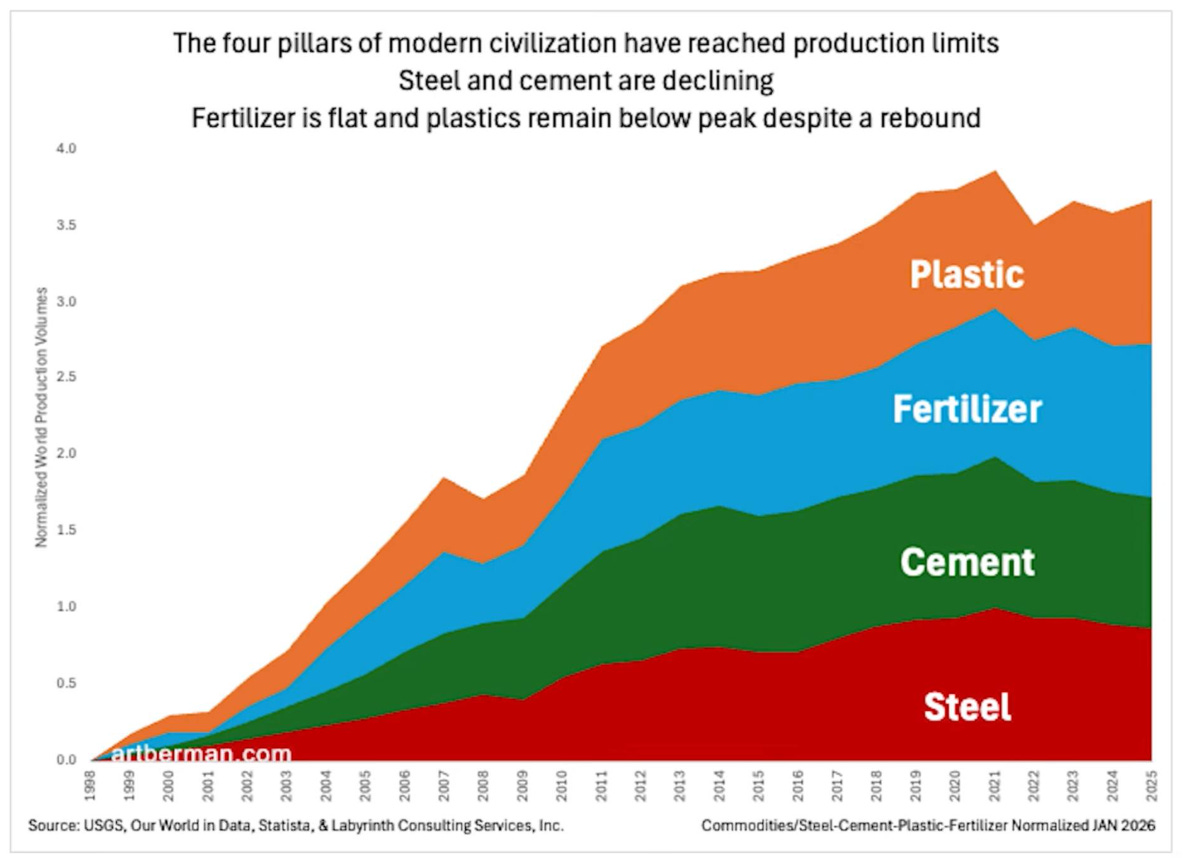
The constraints of the year 2126 appear to be here, now.
Conclusion
We may have run out of time for solutions. That’s certainly the case from a climate perspective. We may have to make do with what we have and get creative. We know 100 years from now, people will be meeting their needs with far less of what we call wealth than we have now. We just have to figure out how they do it.